


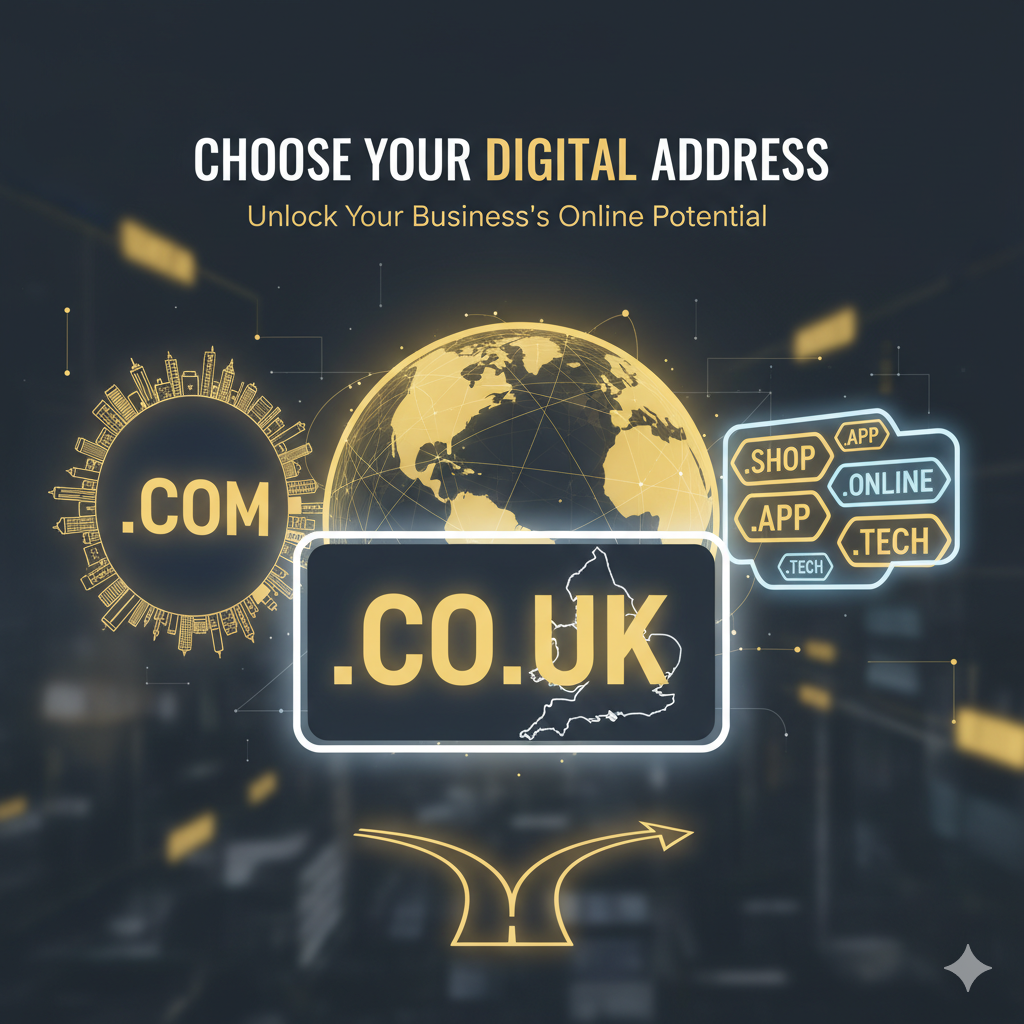
Choosing Your Digital Address: The Essential Guide to .co.uk, .com, and Other Domain Endings for Small Businesses
Every successful small business needs a great address. For a physical shop, it’s a location people can easily find and trust. Online, that address is your domain name, and the most critical part of it—the bit that comes after the final dot—is called the Top-Level Domain (TLD) or domain extension.
Choosing the right TLD is one of the most important branding and marketing decisions you’ll make. It’s not just a technical detail; it’s a signal to your customers, your competition, and, crucially, to Google and other search engines.
For UK-based small business owners, the choice often boils down to a classic battle: the global appeal of .com versus the local trust of .co.uk. But the internet has exploded with options, meaning you now have hundreds of other choices, from .net and .org to descriptive extensions like .shop, .app, and .ltd.
This comprehensive guide will break down the essential differences, reveal the hidden risks, and explain the costs so you can confidently pick the perfect digital foundation for your brand.
What Exactly is a TLD? (The Jargon-Free Explanation)
Before we dive into the specifics of each domain ending, let’s quickly establish what a TLD is and why it matters.
Imagine your entire website address, or URL (Uniform Resource Locator), is a street address:
https://www.YourBusinessName.co.uk
The TLD is the final part: the .co.uk. It acts like the postcode or the country name on an envelope, providing immediate context about the website.
The Internet’s Global Traffic Controller: ICANN
All TLDs are managed and governed by a global non-profit organisation called ICANN (The Internet Corporation for Assigned Names and Numbers). Think of ICANN as the ultimate traffic controller for the internet. They ensure that every web address is unique and that the entire system works seamlessly across the globe.
ICANN categorises TLDs into different types, but for a small business owner, the two most important categories are:
- Generic Top-Level Domains (gTLDs): These are domains that don’t relate to a specific country. Examples include .com, .net, .org, and newer ones like .shop or .tech.
- Country-Code Top-Level Domains (ccTLDs): These are two-letter extensions reserved for a specific country or territory, such as .uk (United Kingdom), .fr (France), or .de (Germany).
The Classic Battle—.com vs. .co.uk
The decision between a .com and a .co.uk is fundamental for a UK-based business. The correct choice depends entirely on your target audience and your ambition.
The Global Standard: .com (Commercial)
The .com TLD stands for commercial and is the undisputed king of the internet.
| Aspect | Summary for Small Business Owners |
| Origins | One of the original TLDs, registered in 1985. It quickly became the default for businesses worldwide. |
| Key Benefit | Universal Trust and Recognition. It is the most recognised and trusted domain extension globally. If customers can’t remember your TLD, they will type .com by default. |
| Audience | Global. Ideal for e-commerce stores, tech startups, or any business aiming to serve an international market. |
| SEO Impact | Neutral/Global. Google treats .com as a global domain. While it won’t give you an automatic local boost in the UK, you can use Google Search Console to tell Google you primarily target the UK audience. |
| Availability Risk | High. Because it’s the most popular, finding a short, memorable .com domain that isn’t already taken is extremely difficult and often requires choosing a less-than-perfect name. |
| Cost | Moderate. Prices are competitive, typically ranging from £8 to £20 per year for standard registrations, though “premium” or in-demand names can cost thousands. |
The Local Champion: .co.uk (Company, UK)
The .co.uk TLD is part of the UK’s official domain system. The co is a Second-Level Domain (SLD) that signals a commercial entity, under the main uk country code.
| Aspect | Summary for Small Business Owners |
| Origins | The .uk TLD was registered in 1985, shortly after .com. The popular .co.uk structure was established for commercial use under the .uk umbrella, managed by the UK registry Nominet. |
| Key Benefit | Local Trust and SEO Advantage. It instantly signals to UK customers that you are a local, reputable, and trustworthy business. Research suggests UK consumers prefer to shop on .uk sites. It is a powerful signal to search engines that your business is relevant to searches originating in the UK. |
| Audience | United Kingdom. Ideal for local shops, service providers (plumbers, accountants, etc.), or any business whose primary customer base is within the UK. |
| SEO Impact | Strong Local Signal. Google inherently recognises .co.uk as targeting the UK. This gives you a slight advantage in UK-based search results over a globally-set .com. |
| Availability Risk | Moderate. While the best names are taken, you have a much higher chance of securing a great, brandable name with a .co.uk ending compared to .com. |
| Cost | Low. Often the cheapest option, with introductory prices sometimes as low as £1 to £5 for the first year, with renewals typically costing £5 to £15 per year. |
The New UK Shortcut: .uk
In 2014, Nominet introduced the shorter, simpler .uk domain (e.g., yourbusiness.uk) as a direct competitor to .com.
- Benefit: It’s short, snappy, and often has more desirable names available.
- Catch: If you owned the equivalent .co.uk before June 2014, you had an automatic right to the .uk version until mid-2019. This means you must check if a different company owns the .uk version of your existing .co.uk domain to avoid confusion.
Other TLD Options: When to Go Beyond the Classics
The internet now offers hundreds of other options beyond .com and .co.uk. These fall into two main categories: the Traditional Alternatives and the New Generic TLDs (nTLDs).
Traditional Alternatives
These have been around for decades and carry a high level of trust and name recognition, especially when the desired .com is unavailable.
| TLD | Stands For | Best For | Risk/Consideration | Cost (Typical Annual) |
| .net | Network | Tech companies, hosting, or when .com is taken. | Can imply an IT-focused business, which might confuse non-tech users. | £10 – £25 |
| .org | Organisation | Non-profits, charities, or community groups. | Using it for a pure profit-driven commercial business can confuse visitors. | £10 – £25 |
| .ltd.uk | Limited Company | UK Private Limited Companies. | Very specific, strong sign of a formal UK business structure. | Low (Similar to .co.uk) |
| .me.uk | Personal | Personal blogs, portfolios, or sole traders. | Not ideal for large-scale commercial businesses. | Low (Similar to .co.uk) |
| .biz | Business | Purely commercial use, often an alternative when .com is unavailable. | Less common and can sometimes be associated with lower-quality sites. | £15 – £30 |
The New Generic TLDs (nTLDs)
Since 2014, ICANN has allowed for hundreds of new, descriptive domain endings, giving small businesses a great chance to get a truly relevant and brandable address.
- Examples: .shop, .app, .london, .store, .photography, .tech, .online.
Benefits of nTLDs:
- Enhanced Branding: A name like
SarahsCakes.shopis arguably better thanSarahsCakes247.com. It incorporates your brand and product directly into the address. - Availability: You have a much higher chance of finding a short, perfect domain name.
- Clarity: They instantly tell the user what your business does (e.g., a .legal site is about law).
Risks of nTLDs:
- User Trust: They lack the decades of trust enjoyed by .com and .co.uk. Some users are still wary of extensions they don’t recognise.
- Memorability/Typing: While your domain might be
BrandName.shop, customers might default to typingBrandName.com, leading to traffic leakage to a competitor or an empty page. - Cost: Some nTLDs, especially desirable ones like .app or repurposed ccTLDs like .io (originally British Indian Ocean Territory, now popular with tech), can be significantly more expensive than a .com or .co.uk, especially on renewal.
SEO Verdict on nTLDs: Google has repeatedly stated that new TLDs like .shop or .app do not get an inherent search ranking boost just because the TLD contains a keyword. Your ranking is still based on the quality of your content, your site speed, and who links to you. However, a relevant TLD can improve your Click-Through Rate (CTR), as a customer searching for a product may be more likely to click on a clear .shop link.
Costs and Hidden Fees to Watch Out For
Domain registration is generally inexpensive, but the costs can vary wildly depending on the TLD, the registrar, and whether you’re purchasing a premium name.
The Three Costs of a Domain Name
When looking at prices, small business owners must consider three distinct costs:
- Registration Price (Year 1): This is often heavily discounted, with registrars offering a .com or .co.uk for as low as £1 to £5 to get your business in the door.
- Renewal Price (Years 2+): This is the true cost of the domain. After the first year’s promotion, the price often jumps to the standard rate, which can be 3 to 10 times higher. Always check the renewal fee before buying.
- Premium Price: If you are trying to buy a highly desirable or short name (e.g.,
cars.com), it may be listed as a “premium” domain. These names can cost hundreds or even thousands of pounds because they are pre-owned or deemed extremely valuable by the registry.
| TLD Category | Typical Annual Renewal Cost (Estimate) | Cost Variance |
| .co.uk & .uk | £5 – £15 | Very consistent and cheap. |
| .com, .net, .org | £12 – £25 | Consistent across most registrars. |
| New gTLDs (.shop, .online, .tech) | £20 – £50+ | High variance; some new TLDs are very cheap, while others are priced higher to reflect niche value. |
| Repurposed ccTLDs (.io, .ai) | £30 – £90+ | These are almost always more expensive and have high renewal rates. |
The Value of Your Domain: It’s an Investment
While a domain might cost you only £15 per year, its value to your business is priceless.
- A well-chosen domain is a brand asset.
- A great domain makes your marketing materials look professional.
- The right TLD can save you time and money on local SEO.
Do not choose a bad domain just because a good one with a cheaper TLD is available. The extra cost for the right domain is almost always worth the investment in trust and branding.
SEO and Branding: Making the Right Strategic Choice
Search Engine Optimization (SEO) is the process of helping search engines like Google understand what your website is about so they can show it to the right customers. Your TLD plays a direct role in this.
SEO and Geographical Targeting
The biggest SEO difference between gTLDs and ccTLDs is geographical targeting:
- The .co.uk Advantage: Choosing a .co.uk is the strongest possible signal you can give Google that your website is specifically targeted at users in the United Kingdom. When a UK customer searches for “plumbers near me,” a .co.uk site for a UK-based business will be automatically prioritised. This is the core reason for a UK-focused business to choose the local TLD.
- The .com Neutrality: Google treats a .com as a global, un-targeted domain. While this is great for a multinational corporation, a small UK business using a .com needs to do more work. You must go into Google Search Console and manually specify that your target region is the United Kingdom. If you fail to do this, Google might rank you lower in UK searches, assuming your content is equally relevant to a global audience.
Brand Protection and Multiple Domains
The single biggest risk, regardless of which TLD you choose, is brand confusion and loss of traffic.
- The Traffic Leak Risk: If your business is called SuperBikes, and you register
SuperBikes.co.uk, a customer who can’t remember the extension will likely typeSuperBikes.comfirst. If a competitor or a domain squatter owns the .com (or vice-versa), you lose that customer forever. - The Solution: Secure Both! For maximum brand protection and to mitigate traffic leakage, the recommended strategy for small businesses with an eye on growth is to buy both the .com and the .co.uk. You then set the one you don’t use (the secondary one) to redirect to your main website.
- If you are UK-focused: Use .co.uk as your main site and redirect the .com to it.
- If you are Global-focused: Use .com as your main site and redirect the .co.uk to it.
This strategy ensures that every customer, regardless of which TLD they remember, ends up on your main website.
Final Verdict: Which TLD Is Right for Your Small Business?
The ultimate choice comes down to a clear understanding of your current business focus and your long-term expansion goals.
Choose .co.uk (or .uk) if:
- Your customers are exclusively or predominantly in the UK.
- You are a local service provider (tradesperson, restaurant, accountant, local shop).
- You want the strongest possible local SEO signal and to build immediate trust with British consumers.
- Your budget is tight, as these are typically the cheapest to register and renew.
Choose .com if:
- Your product is digital or easily shipped globally (SaaS, digital products, international e-commerce).
- Your business has a global customer base or plans to expand internationally within the next 2-3 years.
- You value universal recognition and want your brand to feel established on the global stage.
- You are prepared to manually set your geographic target to the UK in Google Search Console.
Choose a New gTLD (.shop, .tech, .online) if:
- The perfect .com and .co.uk for your brand name are unavailable.
- You want a domain that is hyper-relevant to your industry (e.g., a coffee company using .coffee or a recruitment firm using .jobs).
- Your brand is modern and disruptive and you want to stand out from the crowd.
- You are comfortable with a potentially higher renewal cost and the risk of customers typing .com by mistake.
Choosing your domain ending is the moment you plant your flag on the internet. By understanding the origins, the subtle differences in SEO, and the full costs of a .co.uk, a .com, or any other TLD, you can ensure your digital address is the perfect foundation for your small business to grow.
Ready to get your business out there? Book A Discovery Call to get started or if you want to get going on your own you can register your domain directly and even order your own hosting by visiting our Hosting Services page
